Reflecting on a Movement and a Man of Apostolic Proportions
The recent desecration and defacing of the Haystack Monument on the campus of Williams College in Williamstown, Massachusetts, seems to be just another in a series of similar assaults on traditional religious and political institutions. It occurs to me though, that most Americans do not appreciate the significance of the humble and largely unknown Haystack Monument.
The monument reflects on a seminal event that launched a seismic sized movement more than two centuries ago, when five students at Williams College met to pray in a meadow during a late summer storm in 1806, finding shelter under a haystack. Notable church historian David W. Kling has stated that “This incident . . . became the pivotal event in the launching of American Protestantism’s foreign missionary movement.” Organizations such as InterVarsity Christian Fellowship rightly claim a share in the legacy of the “Haystack Prayer Meeting.”
Of the five students who met to pray on that summer day, one individual, Samuel Mills, Jr., a resident of Torringford, Connecticut, stands out. He might be described as the spark God used to ignite the Haystack and spread missionary fervor throughout the nation and the world.
With a desire to serve God in distant places burning within him, young Mills was sent to Williams College for training. His circle of closest friends included Francis Robbins of Norfolk and Harvey Loomis of Torringford. Joined by Byram Green and James Richards, the young band met to pray, and to discuss the prospects of taking the Gospel to Asia. Under the famous haystack, during a torrential downpour accompanied by thunder and cracks of lightening, they committed their lives to serving God anywhere He might send them.
By 1808, the little prayer band for missions at Williams had grown and became an organized student movement called the Society of Brethren. Mills traveled from Williams to Andover College in Boston to organize a student missionary society there. In 1810, at the request of the Society of Brethren at Andover and at Mills’ urging, the American Board of Commissioners for Foreign Missions was organized. In 1812 the first American missionaries were sent out to India.
Oddly enough, Mills was not among those who sailed for India in 1812. Mills’ greatest desire had been to serve as a foreign missionary, but the American Board of Commissioners felt differently. They encouraged him instead to explore the possibilities of missions at home in New England, particularly among Native Americans. Mills’ accomplishments over the next few years were nothing short of amazing.
After graduating from Williams College, Mills began by enrolling for a year of study at Yale, with the purpose of completing his education and promoting missions among the students there. It was at Yale that he met Henry Opukahaiah, a young stowaway from Hawaii. Mills encouraged Opukahaiah’s vision of bringing Christianity to Hawaii, and shortly thereafter Opukahaiah’s tearful pleas for missionaries to the South Pacific resulted in the founding of the Foreign Missionary School in Cornwall, Connecticut to bring that vision to reality.
Samuel Mills went on to become a founding member of the American Bible Society and the Mariners Bible Society of New York. He traveled into the Mississippi River Valley and beyond, ministering to the Native Americans living in that region. In 1816 he worked in the slums and ghettos of New York City, combining social service among the poor with zealous proclamation of the message of the Gospel. Finally, in 1817, his call to a foreign land was fulfilled. Characteristically ahead of his time, Mills sailed on an expedition to West Africa with a vision of African Americans reaching indigenous Africans with the Gospel of Christ. On the return voyage, Mills fell ill and died at sea, at the age of only 35. His body did not return home, but his heart and passion for missions survive today.
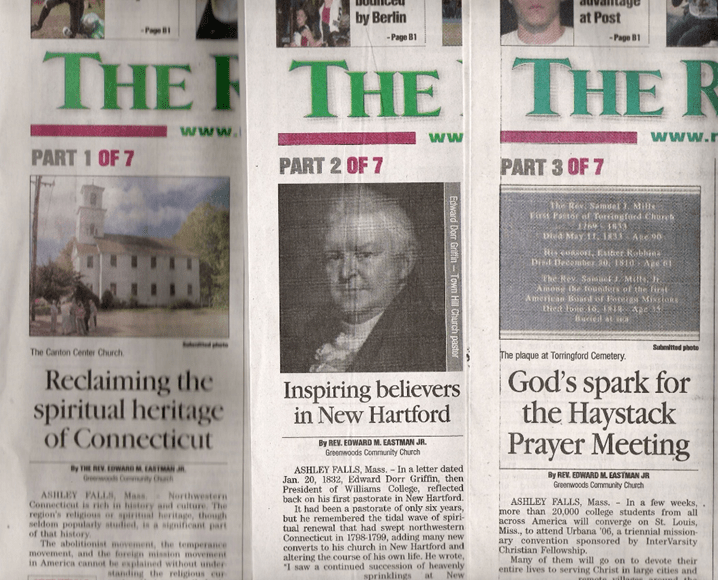
Adapted in part from “God’s Spark for the Haystack Prayer Meeting” Spiritual Heritage Series: Part Three of Seven, Published in the Register Citizen, November 19, 2006

 Hidden Arrows
Really good stuff! As well as reminder of the history you dug up so many years ago now. Bummer about the defacing of the monument, though. Christianity is under attack in this country like never before. Blessings – Chuck
LikeLike
Hi Ed,
I remember the first stop on our bus tour as Samuel Mills, Jr’s memorial stone in the Torringford graveyard. You explained that Mills was not in the grave for he had been buried at sea off West Africa. You had the group offer up prayers and I recall my prayer visited Ezekial 37 and dry bones coming to life. Just want you to know what a life-changing day that tour of northwest Connecticut graveyards had on me. Thank you for all the work and research you put into your dissertation.
At this point in my life my interest in traveling is not high, but if ever I make it to Hawaii my sole interest will be to visit Henry Opukahaiah reinternment grave and memorial.
predestined to eternally be your friend
LikeLike